

Democracy Is More Than Majority Rule
Too often, people misunderstand what democracy actually means. Arguments like “the majority wants it, so we must do it” or “religion is taught in schools because most people are religious” come up constantly — but do they actually hold up to scrutiny?
At first glance, they might seem reasonable. If most citizens are Catholic, why shouldn’t Catholic teaching appear in public schools? To answer that, we first need to understand what democracy really is.
Democracy Is a System, Not a Voting Machine

Democracy is not simply majority rule. It is a system of government in which citizens elect representatives to govern on their behalf — and crucially, those representatives are accountable both to the majority and to every individual citizen.
There is, of course, a more direct form: direct democracy, as practised in Ancient Athens, where citizens voted personally on laws and legislation rather than delegating that power to representatives. It sounds appealing in theory, but it comes with serious flaws. It is impractical at scale, it demands enormous time and expertise from ordinary people, and — most importantly — it leaves minority groups dangerously exposed. When the majority decides everything, almost nothing good can come to those outside it.
The Tyranny of the Majority

This points to democracy’s fundamental vulnerability. Left unchecked, a majority could theoretically vote to legalise slavery, strip rights from unpopular groups, or even dismantle democracy itself by handing power to a single ruler. These are not mere hypotheticals — they are logical conclusions of unlimited majority rule.
That is why no functioning democracy allows the majority to decide everything. There must be firm limits on what can be put to a vote, and robust protections for individuals against the will of the crowd. After all, any one of us can find ourselves in a minority based on some characteristic or belief.
Rights Are Not Up for a Vote
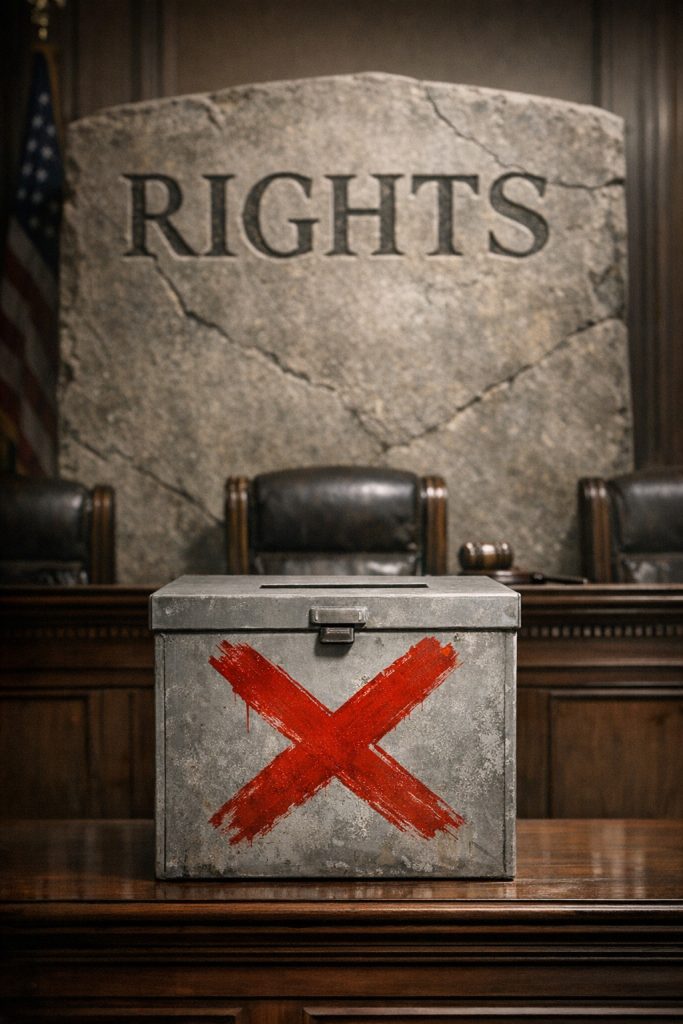
Applying this to religion in schools makes the problem clear. Allowing the majority to impose its religion on everyone else does not just inconvenience minorities — it actively harms their right to a fair, secular education, particularly when certain religious teachings contradict established science.
The government’s role is not to amplify the majority’s power but to protect citizens from it. The tyranny of a king must not simply be replaced by the tyranny of a crowd.
This is why rights cannot — or at least should not — be subject to popular vote. If we permit voting on gay marriage, there is no principled reason to prohibit voting on interracial marriage. The logic is identical, and the danger is the same. Once rights become subject to majority approval, no minority is truly safe.
What Qualifies as a Right?
Defining rights is genuinely difficult, but a useful baseline is this: if an activity harms no one — neither the people practising it nor anyone else — there are no legitimate grounds to restrict it, legislate against it, or discriminate against those who engage in it. Two people marrying, regardless of their gender, affects no one outside that relationship. Mandatory religious observance in a shared classroom, by contrast, directly excludes and disadvantages those who do not share that faith.
That distinction matters. Democracy works best not when it empowers majorities to get everything they want, but when it balances collective decision-making with an unwavering commitment to individual rights.