
Quick Answer
Here’s the best part upfront:
- I had hands-on Experience
- I read and followed the official Microsoft Study Guide
- I got the Practice Test and kept using it right up until the exam
- I took notes
- I tried to study consistently
If you are interested in details, keep reading.
What is PL-600?
PL-600 is a final exam you must pass on your journey toward earning the Microsoft Certified: Power Platform Solution Architect Expert Certification, one of the highest-level credentials you can earn in the Microsoft Dynamics 365 and Microsoft Power Platform worlds.
Why?
Well, after I passed the PL-400 exam and earned the Power Platform Developer Associate Certification, it seemed only natural to take this a step further, especially as the Power Platform Developer Associate Certification is a prerequisite for the Power Platform Solution Architect Expert Certification.
As to why I would be interested in going down this path at all, it is pretty simple: I am not “simply” a developer, but an IT Consultant. And how does a Consultant demonstrate Knowledge? Certification.
Certification will indeed distinguish and separate you from others, as it not only demonstrates Knowledge and skill but also discipline and the desire to improve yourself.
And, on a personal note, it gives you a sense of achievement and even improves life satisfaction.
How?
Let’s begin with the obvious: this exam is quite complex. You cannot pass it without proper preparation, even if you have worked with the Power Platform for several years. This is because you may not have encountered every aspect of the platform during that time, and there may be areas that you are not entirely familiar with or even aware exist.
On top of that, you need to be at least somewhat familiar with software ALM, techniques to discover customers’ needs, and change management. In short, you need technical Knowledge and skills with Power Platform, as well as functional skills to connect with business users and deliver a solution that meets business needs.
1. I had hands-on Experience
You can’t pass this exam without practical Experience. I have Experience creating solutions, designing security, and planning deployments. In addition, I have Experience combining multiple Power Platform components and identifying where a solution might need to be augmented using custom development hosted in an Azure Service, for example.
2. I read and followed the official Microsoft Study Guide
This is probably how you will also start, as it naturally makes sense to go straight to the source and see which themes the exam actually covers.
- Perform solution envisioning and requirement analysis (45–50%)
- Architect a solution (35–40%)
- Implement the solution (15–20%)
The most important resource is the Course PL-600T00-A: Microsoft Power Platform Solution Architect, which offers valuable lessons, even if they are not particularly deep.
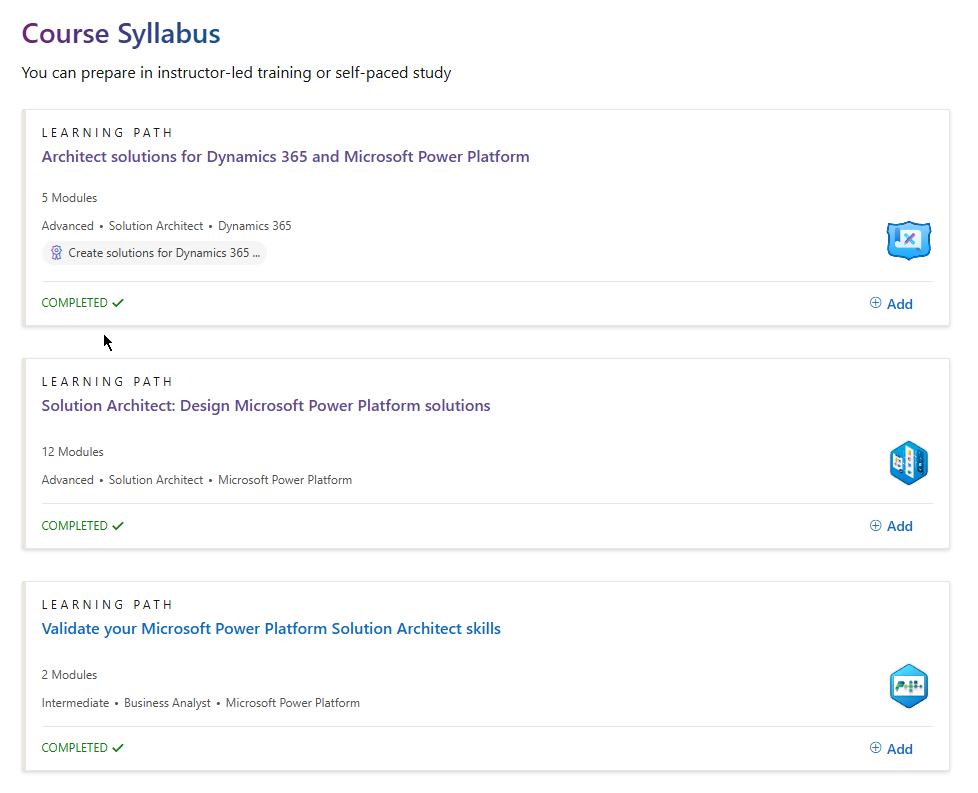
Logging in with your private account is highly recommended, as it allows the site to track your progress through the study guide, which is a nice bonus feature. The lessons there are clear and understandable, provided you also do the exercises.
An additional crucial point about the lessons and exercises provided in the Course is that you should not only try to understand how something is done, but also the motivation behind the provided designs. The “WHY” is essential.
3. I got the Practice Test and kept using it right up until the exam
As with the PL-400 exam, I have used a practice test to identify topics I need to study further and to get a feel for the actual exam. And more importantly, I purchased long-term access to the practice exam and used it intensively up to the exam date. The Practice Test I used is the one from MeasureUp: Microsoft PL-600 Solution Architect Practice Test| Exam Simulation.
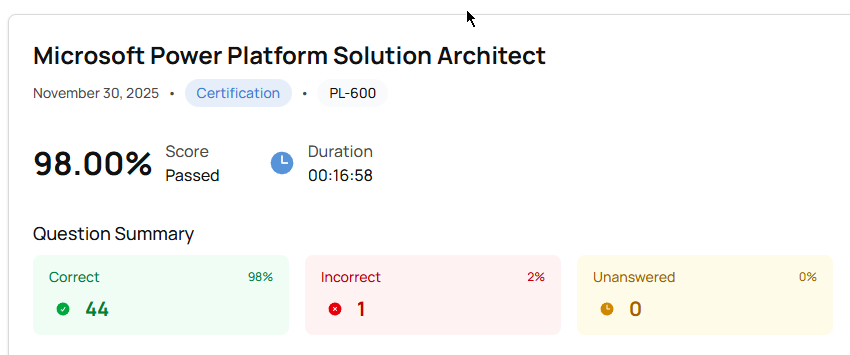
Although you may not encounter the same questions on the actual exam, I can assure you that you will see similar types of questions. The exam’s user interface also resembles the real one, at least as far as I recall.
The concept is straightforward: there is a pool of approximately 160 questions that are displayed to you randomly, based on the specific area you want to focus on while practising for the exam.
You can choose between:
- Certification Mode aims to mimic the actual certification exam as closely as possible, with a time limit and no opportunity to check answers before completing the test. However, because this can last more than an hour, I suggest avoiding it if you’re in a hurry, are hungry, or have any other reasons to rush through the test.
- Practice Mode is your playground where you can decide which area you wish to be quizzed in, how much time you want, how many questions you want and whether you should have the ability to check the answers during the test.
Whether you’re using the Certification or Practice mode, your session is recorded in attempt history, allowing you to review it at any time to identify the questions you answered incorrectly.
The answers provided are comprehensive and helpful. They not only explain why a particular answer is correct, but also clarify why the other options are incorrect. Additionally, you receive direct links to the relevant sections of Microsoft Documentation so that you can read more about the topics yourself. I highly recommend this resource.
Also, let’s not forget that Microsoft offers a free Practice Assessment, but I personally still found one on MeasureUp invaluable. That is not to say that the one from Microsoft is useless; MeasureUp is better.
NOTE: I am not an affiliate! I endorse only products and services that I have personally tested and found valuable, as one way to give back to the community.
4. I took notes
Generally, in life, I take a lot of notes; even if something is well documented, I would go so far as to say that taking notes is often my edge, or a secret weapon, for getting ahead in life and in business. Mind you, I am not that far ahead, but I still think the principle is sound.
While reading the Resources on Microsoft Learn, I took detailed notes. I did not copy the content from the screen into my notes mindlessly either. I was always trying to focus when reading, find the essence and the most essential parts of what the materials were saying, and then write them down.
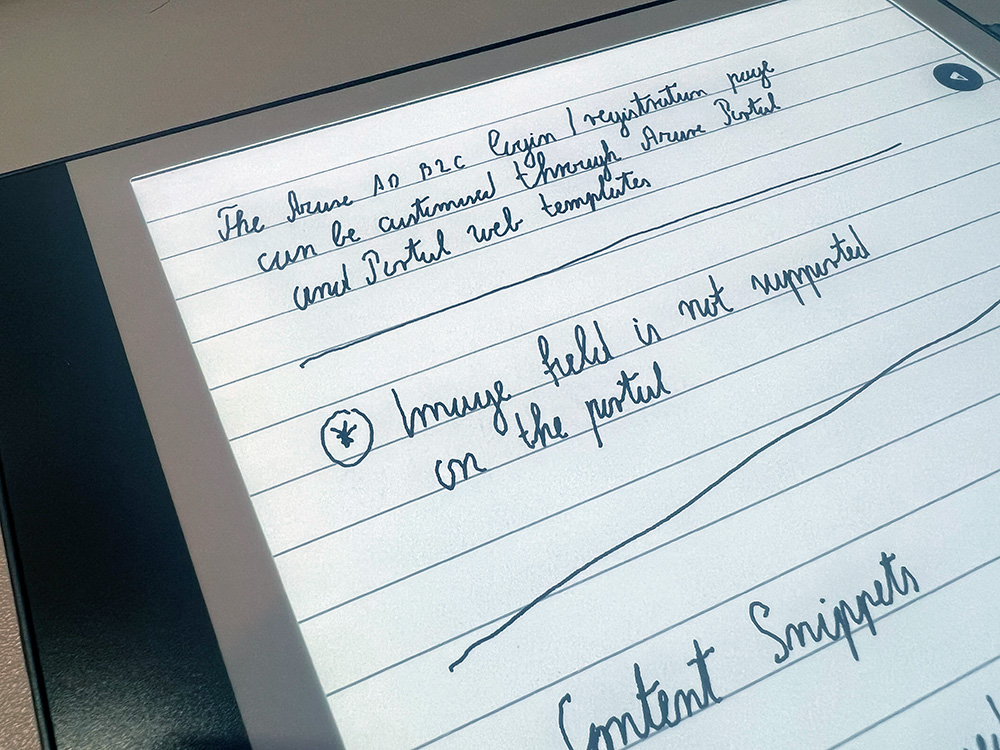
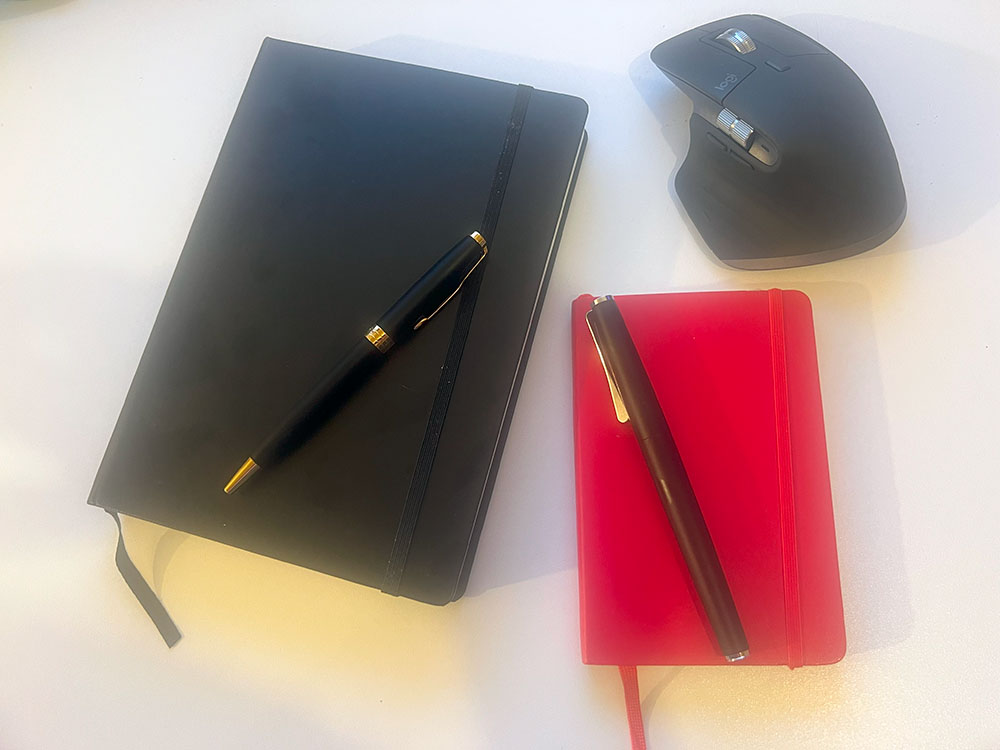
One thing I would suggest, though, is to make notes on paper or an e-ink tablet. The reason is that it’s somewhat too easy to fall into the trap of simply copying the course content into a notetaking app without thinking about those notes and, consequently, not processing the material.
I did the same thing when analysing the results of my attempts at MeasureUp Practice Tests.
Personally, I have migrated from paper notebooks to the notebook function on my Kindle Scribe for writing and taking notes, as described in my previous post, “Reasons to buy a Kindle Scribe” A pen-and-paper method is certainly more than good enough and better than any digital notetaking app. There really is something in writing by hand (even when using an e-ink device) that makes us commit more things to memory – and more deeply, at that.
5. I tried to study consistently
Yes, I tried to study consistently. But I did not always succeed. I did try, though. And that turned out to be enough.
As I wrote in the “3 Straightforward Steps to Get Things Done” post, even working on something for 5-10 minutes daily will eventually yield results.
I usually told myself that I would work on it only for a set amount of time. It can be an hour, half an hour, 10 minutes or even 5 minutes. I just tried to do it every day.
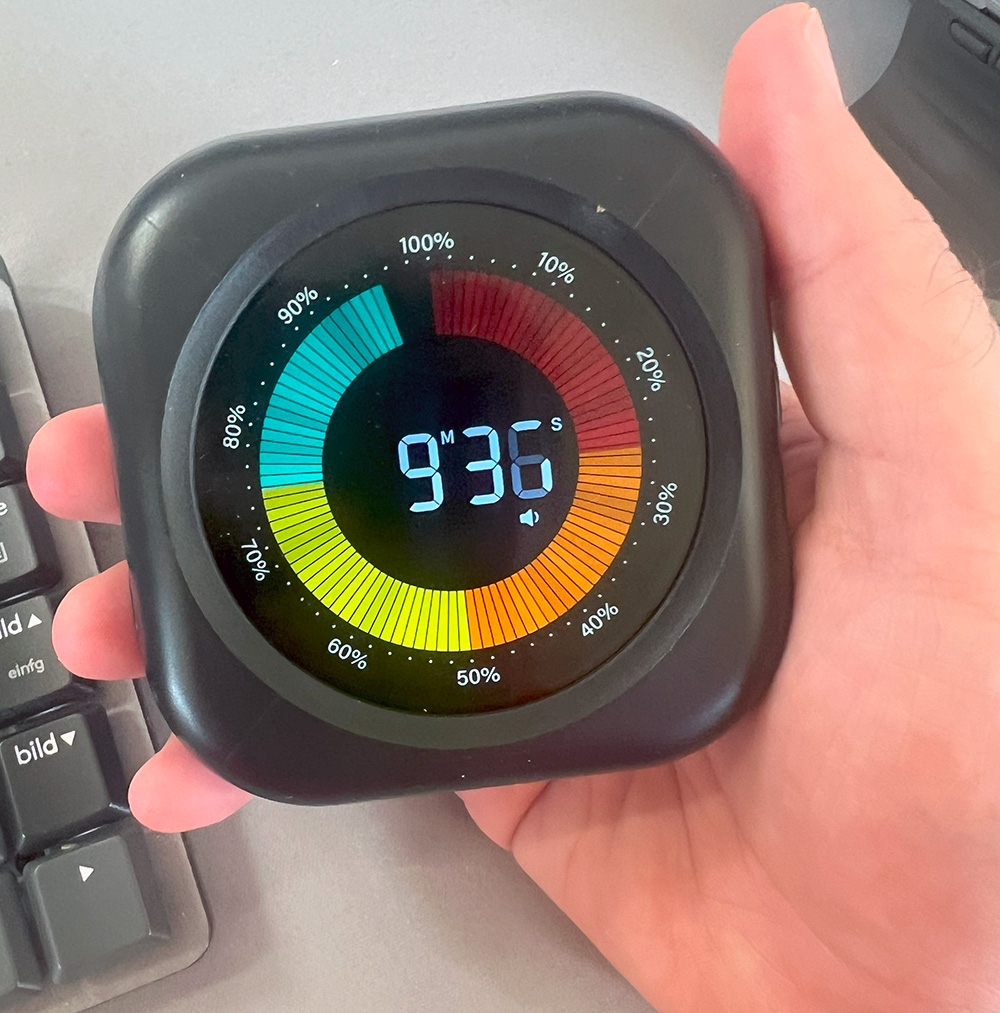
We are all human. We all sometimes feel overwhelmed. What is important is that we do not give up and try again, maybe move forward without being too hard on ourselves. And we will get there, eventually. Good luck!